
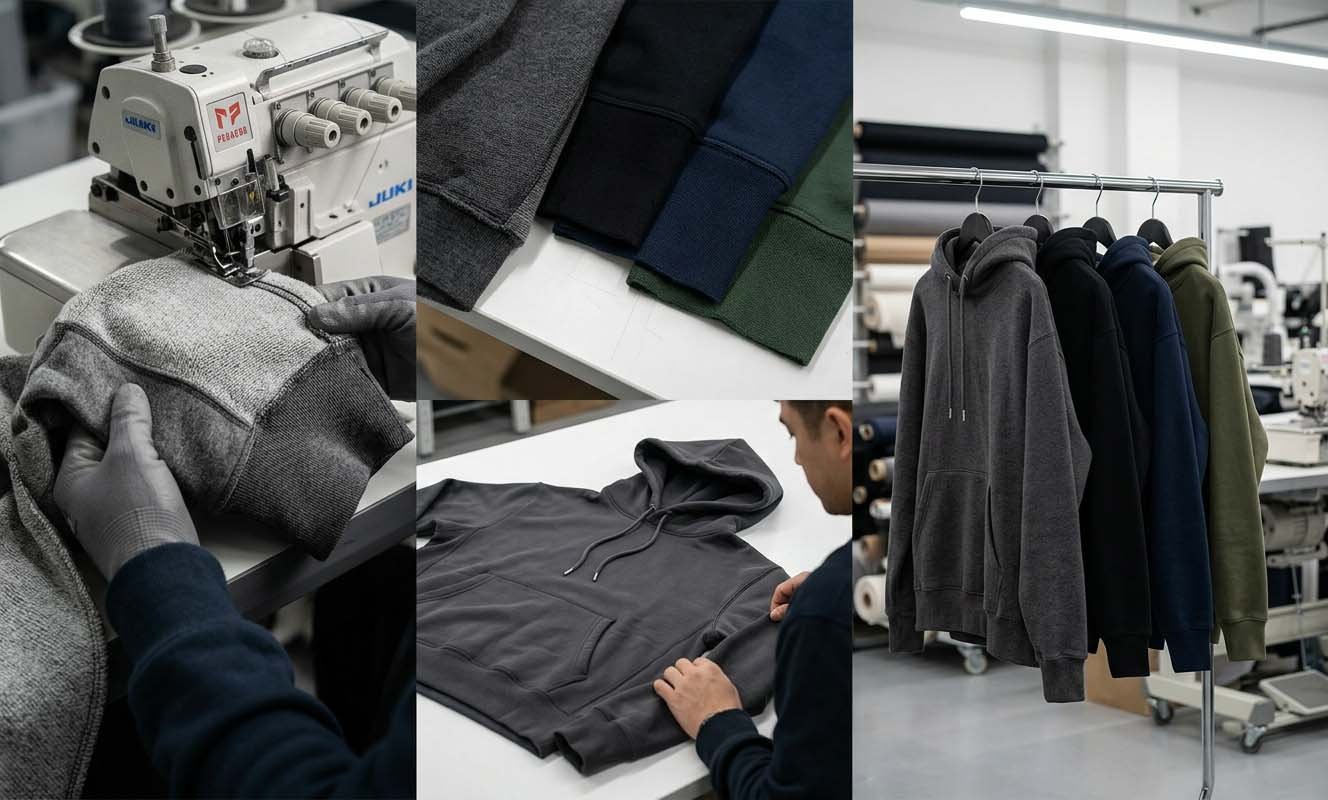

This guide is written for brand owners and product developers who want to understand how heavyweight fleece hoodie manufacturing actually works on the factory floor — fabric structure, rib matching, shrinkage control, hood construction and the print/embroidery decisions that hold up on thick, dense fabric.
GSM Benchmarks: What “Heavyweight” Actually Means
GSM (grams per square meter) measures fabric density, not quality. It’s a useful shorthand once you know the ranges typically used in the industry, but it should always be read alongside fiber content and knit structure.
| Weight Class | Typical GSM Range | Common Use |
|---|---|---|
| Lightweight | ~250–300 GSM | Warm-weather sweats, layering pieces |
| Midweight | ~320–360 GSM | Standard retail hoodies, promotional wear |
| Heavyweight / streetwear | ~380–500+ GSM | Structured, boxy silhouettes, premium drape |
These bands are industry convention rather than a fixed technical standard — different mills round differently, and a fabric labeled “420 GSM” can vary a little batch to batch. Treat GSM as a target range to confirm on your lab dip and bulk fabric report, not a number to chase to the decimal point.
French Terry vs. Brushed Fleece
These two constructions get lumped together as “fleece,” but they behave differently, and the difference matters for both hand feel and print finish:
- French terry has an unbrushed loop-back interior. It’s more breathable, drapes cleaner, and gives you a smoother interior surface for labels and prints — which is why a lot of premium streetwear brands default to it for warmer-climate drops.
- Brushed fleece has that interior loop napped (brushed) into a soft, fuzzy pile. It adds loft and a plush thermal feel without necessarily adding fiber density — two fabrics at the same GSM can feel very different depending on whether that weight is in the loop structure or the brushing.
If you’re deciding between the two, think about climate and end use first, then confirm the GSM range within whichever construction fits.
Fiber Composition: 100% Cotton vs. CVC and Poly Blends
100% cotton is still the reference point for premium streetwear fleece — it takes garment dye and pigment washes more evenly, and it has the hand feel buyers associate with high-end hoodies. But it’s not the only reasonable choice, and it isn’t automatically the right one for every product.
CVC (chief value cotton, typically a cotton-poly blend around 60/40) and poly-cotton blends resist wrinkling better, hold shape through repeated washing, and are generally more dimensionally stable — meaning less shrinkage variance to plan around. For brands doing heavy garment washing or acid/stone wash treatments, that stability can be worth the small trade-off in hand feel. It’s a genuine spec decision, not just a cost-cutting one.
The Construction Details Most Guides Skip
This is where a lot of hoodie sourcing content stops short. Getting the fabric right is only part of the job — how the garment is built around that fabric determines whether it holds up.
Matching Body Weight to Ribbing
A common failure point: a brand specs a heavy 450 GSM body fleece and lets the factory default to a standard-weight rib for the collar, cuffs and hem. Within a few washes the ribbing sags, the cuffs lose recovery, and the waistband stops sitting flat. As a general rule of thumb used in cut-and-sew, ribbing should be matched in weight class to the body fabric — for 400+ GSM bodies, that typically means a heavier 2×2 cotton/spandex rib, not a lightweight jersey rib pulled from a lighter-weight program. If your tech pack only specifies “2×2 rib” with no weight or spandex content, ask your factory what they’d default to — it’s a common gap.
Hood Structure and Neck Taping
Double-layered hoods in heavyweight fleece carry real weight, and unsupported necklines can pull backward under that load — you’ll see the front neck seam drag toward the back of the garment over time. Shoulder-to-shoulder neck taping and a structured collar insert are the usual fixes. If your hoodie has a heavy, oversized hood, it’s worth asking specifically how the factory reinforces the neckline rather than assuming standard construction will hold.
Seam and Thread Selection
Thick fleece puts more strain on seams than lighter fabrics. Standard overlock stitching can pucker or blow out under repeated stress on 450–500 GSM fabric; many factories move to reinforced coverstitching at high-load seams (shoulders, side seams, armholes) and heavier-gauge ballpoint needles designed for dense knits. This is a construction detail worth confirming at the sample stage rather than discovering in a bulk-order complaint.
Shrinkage and Garment Washing
Heavyweight cotton fleece shrinks — that’s expected. The variable is how much, and in which direction. Untreated cotton fleece commonly loses more length than width on first wash, and industry guidance for uncompacted fabric puts that shrinkage in a wide range, often cited around 5–8% before any pre-treatment. Pre-compacting the fabric (running it through a stenter frame or a pre-wash stage before cutting) is the standard way to bring that down, though the exact figure a given mill achieves will depend on their process and should be confirmed with a lab test, not assumed from a general guideline.
If you’re planning garment dye, acid wash, stone wash or any pigment-dye finish, build that shrinkage allowance into your pattern before cutting — not after. A tech pack that specs finished measurements without accounting for post-wash shrinkage is one of the more common reasons bulk orders come back off-spec. Thread choice matters here too: polyester thread behaves differently from cotton thread under dye and enzyme wash, and a mismatch can leave visible seam color shift after washing.
Printing and Embroidery on Thick Fabric
Decoration choices that work fine on a lightweight tee don’t always translate cleanly to 450+ GSM fleece:
- Screen printing — including high-density and puff variants — works well on heavyweight fleece but needs enough ink deposit to sit properly on a textured, brushed surface without looking thin.
- Embroidery needs the right backing (cutaway or tear-away, depending on the design) to prevent puckering — dense fleece can hide light puckering until the garment is stretched, so backing choice matters more than it does on wovens.
- DTF and sublimation depend heavily on fiber content — sublimation in particular needs a high polyester content to bond properly, which is one more reason fiber blend decisions ripple into your decoration options later.
It’s worth deciding your primary decoration method before finalizing fabric composition, since the two aren’t fully independent choices.
Tech Pack Specs Worth Getting Right
For heavyweight fleece specifically, a factory-ready tech pack should include, at minimum:
- Target GSM range and fiber composition (with acceptable tolerance)
- French terry vs. brushed fleece construction, specified explicitly
- Rib weight and spandex content for collar/cuff/hem
- Finished measurements that already account for expected wash shrinkage
- Wash/dye treatment (if any) and where in the production sequence it happens relative to printing
- Seam type callouts at high-stress points, not just a general “overlock” note
The more of this is nailed down before sampling, the fewer rounds of fit and strike-off revisions you’ll need — which is usually the slowest part of getting a heavyweight fleece program into production.
Sampling: What to Check Before Approving Bulk
For heavyweight fleece, it’s worth requesting a strike-off or fabric swatch on pre-shrunk material before approving print or embroidery placement — printing on unstabilized fabric and then seeing it shrink around the design is a preventable mistake. At the PP (pre-production) sample stage, check rib recovery after a wash cycle, neckline structure under the hood’s weight, and seam performance at stress points, not just overall fit and color.
FAQ
What’s the best GSM for a premium streetwear hoodie?
Most heavyweight streetwear programs land in the 380–500 GSM range, but the “right” number depends on the construction (French terry vs. brushed fleece), the climate you’re designing for, and how boxy or structured you want the silhouette. Confirm actual hand feel on a physical swatch rather than choosing by GSM number alone.
How much will my heavyweight fleece hoodie shrink after washing?
It depends on whether the fabric has been pre-compacted and what wash or dye treatment you’re applying. Untreated cotton fleece can shrink meaningfully on first wash; pre-treated fabric shrinks less. Ask your factory for their expected shrinkage figure and build it into your pattern rather than relying on a general industry estimate.
Do I need heavier ribbing for a heavier body fabric?
Generally yes. Pairing a lightweight rib with a heavy body fabric is a common cause of sagging cuffs and waistbands after a few wash cycles. Specify rib weight and spandex content explicitly in your tech pack rather than leaving it to factory default.
Where Axura Fits
Axura Impex works with USA and EU clothing brands on cut-and-sew manufacturing, fabric and material sourcing, and printing, embroidery and washing/finishing — including the kind of construction and shrinkage-control decisions covered above. If you’re developing a heavyweight fleece hoodie program and want to talk through GSM selection, rib matching or your tech pack specs before you sample, reach out to discuss your project.

Have a project in mind?
Whether you have a quick question or you’re ready to develop a product, tell us what you need and we’ll point you in the right direction.
Share as much as you can. A product reference is helpful, but not required.
